Business Travel Super Simplified
Designed for businesses seeking flexibility and a wide range of choices



HR managers are a key part of modern organisations. Their responsibilities go beyond recruitment to include training, performance management, employee well-being and compliance. As businesses continue to evolve, the role of an HR manager is becoming more complex, digital and increasingly important.
The HR industry is expected to grow exponentially, driven by a shift towards more strategic and data-led functions.
When we talk about the duties of an HR manager, the role is often limited to hiring or recruitment. In modern organisations, HR manager responsibilities extend far beyond this and focus on supporting the smooth and compliant functioning of the business.
Today, HR managers are responsible for retaining employees, managing performance and ensuring all workplace policies and labour laws are followed.
Unlike traditional HR roles, the responsibilities of a human resource manager rely on automation and technology to streamline hiring, manage resources, control expenses and optimise time across the organisation.
| Add savings & convenience to your corporate travel! |
Responsibilities of an HR manager in an organisation are more than recruitment, covering multiple people and process functions to keep the work running smoothly. Their key responsibilities include:
Create job descriptions, screen candidates, and manage the hiring process to secure the right talent quickly and support long-term workforce stability.
Implement effective rewards and recognition programmes, support employee well-being, and offer structured benefits to retain employees and reduce recruitment costs.
Manage onboarding, performance reviews, track progress, and provide feedback to ensure clarity in expectations, productivity, and consistent team performance.
Identify workplace conflicts early and facilitate fair resolutions to maintain morale and prevent disruptions.
Manage salary structures, leave policies, insurance, travel allowances, and other expense-related processes accurately and on time.
Oversee employee travel policies, manage corporate travel approvals and ensure travel-related expenses align with organisational budgets and compliance standards.
Create and update attendance, leave, safety, and conduct policies to ensure clarity and consistency across the organisation.
Monitor labour laws, workplace safety standards, and fair employment practices to protect the organisation from penalties and reputational risks.
Apply policies and decisions consistently, building employee confidence and reducing internal conflicts.
Guide managers on leadership, communication, and team development to handle people-related challenges effectively.
HR managers are responsible for shaping the culture in a workplace. To understand the roles and responsibilities of a human resource manager, here’s a glimpse of how they influence employee experience and organisational culture:
An HR manager ensures that company values are communicated clearly and followed consistently. This builds trust, aligns employee behaviour with organisational goals and supports long-term reputation.
By maintaining open communication channels, an HR manager helps employees feel heard and supported. This strengthens engagement and encourages transparency across teams.
Human resource manager duties and responsibilities include designing recognition programmes that acknowledge employee contributions. When recognition is embedded in the workplace, it boosts motivation and improves job satisfaction. Organisations with strong recognition practices often see 31% lower voluntary turnover, showing that recognition directly supports retention and productivity.
They promote inclusive hiring and fair workplace practices. A diverse workforce brings varied perspectives, and organisations that embrace diversity and inclusion often perform better. For example, companies in the top quartile for gender and ethnic diversity on executive teams are 36% more likely to achieve above‑average profitability, and diverse teams make better decisions up to 87% of the time, reflecting stronger problem‑solving and performance outcomes.
An HR manager supports mental and physical well-being through wellness programmes and team initiatives. Health-focused workplaces see reduced burnout, lower absenteeism and better overall performance.
| Unlock efficiency and savings for your business travel today! |
Today’s workplaces are evolving rapidly, with hybrid work, a focus on employee well-being and skills shortages making HR managers more critical than ever.
Their importance is increasing because:
HR managers act as strategic partners, building the right teams, optimising workflows and leveraging tools like MyBiz for smart, tech-first management of employee travel and expenses.
The work of an HR manager now extends far beyond recruitment. They play a critical role in shaping workplace culture, supporting employee success and ensuring compliance across the organisation. More importantly, HR managers help create systems and environments where people can perform consistently and businesses can scale responsibly. As the workforce continues to evolve, organisations that invest in strong HR leadership are better positioned to build resilient, future-ready teams.
| Follow us on LinkedIn for business travel insights! |
Ans. An HR manager is a professional responsible for managing an organisation’s human capital by balancing employee needs, business objectives and regulatory requirements. They oversee areas such as recruitment, employee relations, compliance and workplace culture.
Ans. HR managers use workforce data, performance trends and employee feedback to support leadership decisions. Their inputs help organisations plan hiring, manage costs and align people strategies with business goals.
Ans. Using tools like myBiz, HR managers can automate travel booking, gain predictive insights for resource planning and generate smart reports for real-time visibility across the organisation.
Ans. Yes. HR managers influence culture through policies, leadership guidance, recognition frameworks and communication practices that shape everyday employee experiences.
Related Blogs:
| myBiz - winning customer appreciation every time! |  |  |  |
Our features and benefits are curated to suit the needs of every employee using myBiz.
Who manages company's travel expense
Simplified Admin Panel to manage all employees and their expenses
Detailed reports on regular basis to keep a track on your spends
Dedicated Support Manager from myBiz to take care of your queries
Who books for employees
Book using the traveller's Policy to ensure the right options are booked
Shortlist & share travel options to employees directly from myBiz
Track your requests & get the job done from one single place
Who travel for business
Special Corporate Fares in flights to ensure you get more benefits at reduced price
myBiz Assured Hotels for top-rated stay options
Sanitized Cabs to safely pick & drop you to your destinations
Grab all the corporate benefits by creating your account now
Get started by providing minimal details like employee size, organisation name, etc.
Gain most of the benefits by setting up employee-friendly policies (only Admin users).
Invite your employees to myBiz so that they could enjoy all the corporate benefits.
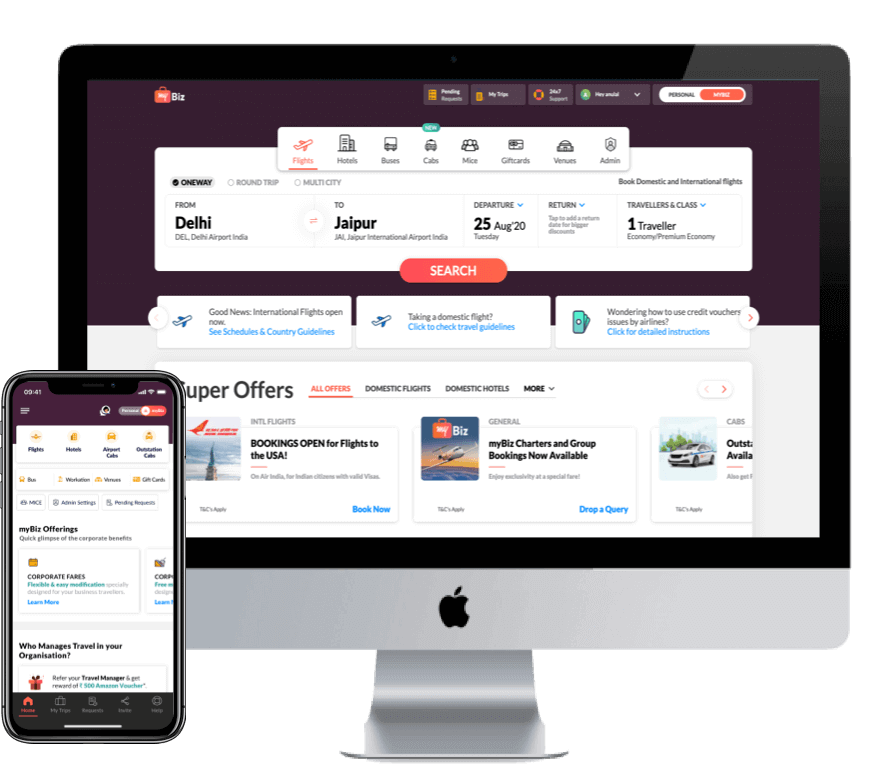
With our super intuitive and connected web application & mobile app, myBiz is always available to address all your business travel needs.




myBiz powers many of the small, medium & large size organisations to help them save on their travel budget and achieve more from their business travels. Read interesting stories from these organisations.